Let’s be honest, most conversations about sustainable marketing stay at surface level. Look familiar?
“Use less paper!” “Go digital!” “Offset your carbon!”
It all sounds good and useful, but sustainability is now often used as a buzzword instead of a system. But if you look closely at how modern direct mail providers like bakergoodchild operate, you start to see something a little more interesting:
Physical mail hasn’t just adapted to sustainability expectations; it’s been rebuilt around them.
Sustainability is Engineered Into the Direct Mail Process
At bakergoodchild, sustainability isn’t just something that’s loosely added at the end of a job. Rather, it’s built into how every campaign is planned, produced, and delivered. We do this because adding a “green” label at the end of a process doesn’t change its impact. Redesigning the core elements of the process itself does.
Our focus is on reducing the environmental impact at the source, from the materials we use to the way campaigns are produced. We don’t believe in just leaving it for later. Let’s take a look at how we get this right.
1. Materials: Rethinking What Mail is Made From
One of the most visible and most important shifts we make is in the materials themselves.
Traditional direct mail has always relied on plastic-based poly-wrap and resource-intensive paper sourcing – bakergoodchild has actively moved away from both.
We’ve introduced:
- 100% compostable poly-wrap made from potato starch, replacing conventional plastic film
- Carbon-balanced paper, where the emissions associated with paper production are measured and offset
To us, this isn’t just a simple material swap; it’s an intentional move away from fossil-fuel-derived inputs toward renewable, lower-impact alternatives.
That said, sustainable alternatives can’t impact performance (otherwise, it’s not a true alternative). So, the materials we now use still deliver the same durability in transit, protection for contents, and, of course, the same high-quality finish our clients expect from our mailing house.
This is super important because sustainability can only work at scale if it doesn’t require trade-offs in quality or reliability.
2. Production: Reducing Waste at Source
Traditional print processes can be resource-heavy, but at bakergoodchild, we focus on reducing waste before it even exists.
We’ve done this through:
- Automation and integrated workflows, which minimise manual handling and errors
- Digital printing over lithographic methods, reducing energy use and material waste
- Data-driven targeting, meaning fewer unnecessary prints and less overproduction
These aren’t cosmetic improvements – they fundamentally change how much material is used in the first place. Because less waste generated = less waste to manage.
3. Operations: Smarter Energy Use and Efficiency
Sustainability isn’t just about the mail itself – it’s also about how it’s produced. This is why we’ve invested so intentionally in our print infrastructure as we want all of our processes to be as energy efficient as possible.
The result is a system where operational efficiency and sustainability are aligned and not left as competing priorities.
4. Carbon Accounting: Measuring What Actually Matters
Here’s where sustainability moves from intention to accountability.
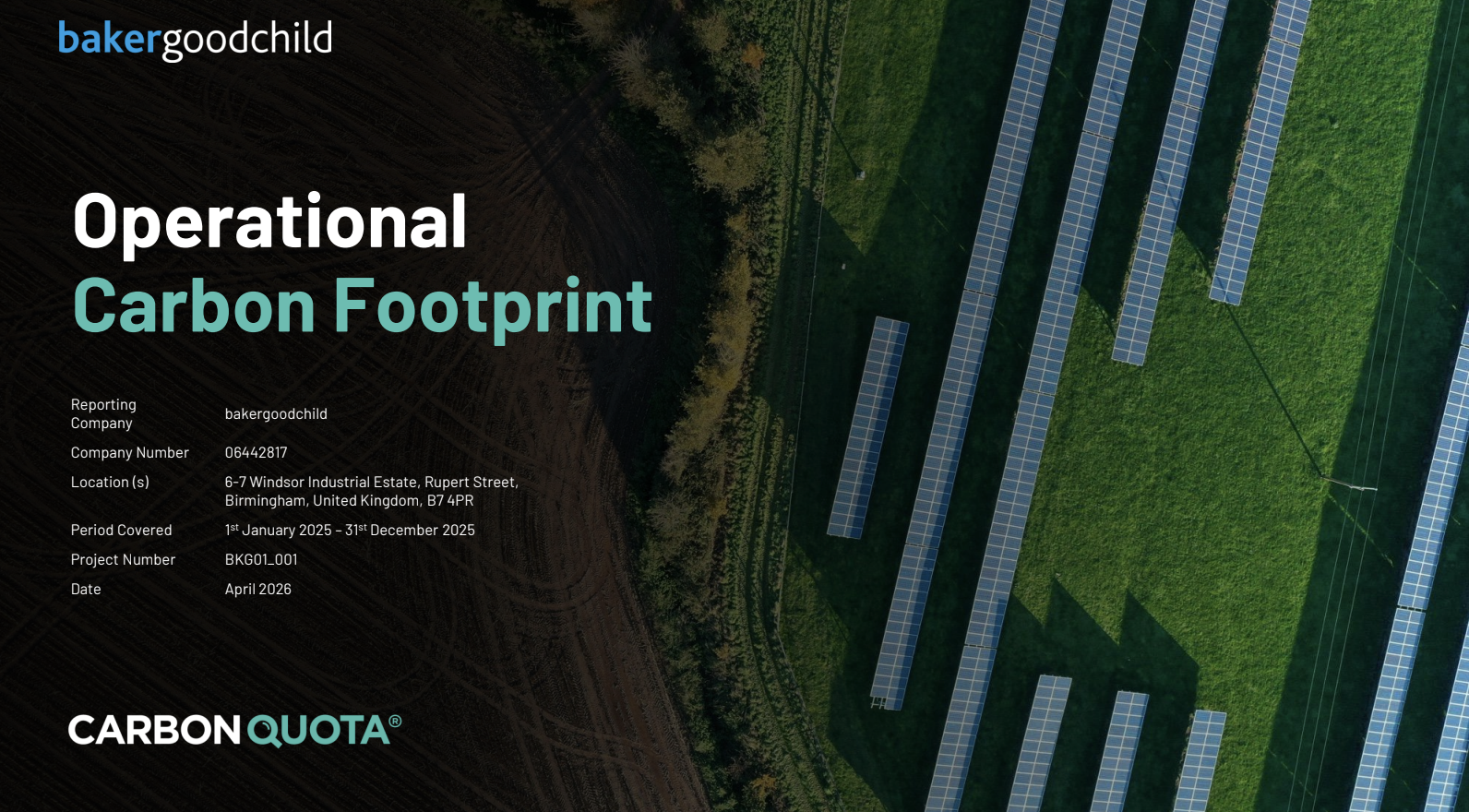
At bakergoodchild we’re not just posturing as environmentally conscious – we’re actually measuring our full operational carbon footprint across Scope 1, 2, and 3 emissions, giving a complete and transparent view of impact.
That includes direct emissions from our company vehicles, the energy consumption used across operations, and even indirect emissions made from our supply chain, travel, and wider business activities.
This matters because without accurate measurement, there’s no meaningful way to reduce impact – only estimate and hold thumbs (not our style). By understanding exactly where emissions come from, bakergoodchild can focus on real, targeted reductions, not assumptions.
The proof is in the pudding – by working with CarbonQuota, we’re now recording our Carbon impact and setting targets to reduce our Carbon emissions.
What This Means for Your Marketing
You’re probably thinking something along the lines of: “all of this only matters if it changes something for me.” And it does.
Working with bakergoodchild means your direct mail isn’t just effective – it’s designed to stand up to scrutiny.
- No awkward sustainability questions: You’re not guessing or hand-waving. The materials, the process, the carbon – it’s all considered, measured, and accounted for.
- No trade-off between impact and performance: You still get high-quality, high-response campaigns – just without the unnecessary waste and outdated materials that are normally behind them.
- No need to build this yourself: The systems, sourcing, and carbon accounting are already in place. You plug into it.
And in a world where clients, stakeholders, and procurement teams are asking increasingly harder questions (and actually expecting specific responses), that matters.
So, is Physical Mail Sustainable?
Sure can be – but only if done properly.
It’s not about the channel – it’s about the approach.
Old-school direct mail earned its reputation. But what bakergoodchild shows is that when you rethink the materials, the production, and the carbon impact from the ground up, the channel becomes something else entirely – controlled, accountable, and built for a far more demanding world.
This isn’t about trying to make print look good on paper. It’s about making sure it actually is good – in practice.
Because sustainability isn’t a message you add to a campaign.
It’s something your campaign should already stand on.